GPU Servers on SERVER1.GE - powerful GPU resources for artificial intelligence, machine learning, LLM inference, 3D rendering, video processing, and high-performance computing tasks. Get
NVIDIA GPU resources for AI/ML, CUDA, PyTorch, TensorFlow, and rendering stacks
Configuration based on project workload: VRAM, CPU, RAM, NVMe, Backup, and Traffic
If you need GPU resources for an AI project, a rendering farm, or video/data processing, send us your request and we will help you choose the right configuration.
You can also view
Dedicated Servers or
VPS Hosting.
Full Root/Admin access - manage the GPU server on your own terms.
OS, Driver/CUDA, Docker, Firewall, and Backup - on request.
Dedicated GPU resources for high workloads
AI, ML, LLM inference, and CUDA stack
SSD, ECC RAM, and fast network
️
Full Root access
Choose a GPU Configuration
A GPU server is selected based on workload: VRAM, CUDA cores, CPU, RAM, NVMe storage, network, and location.
Product
CPU
GPU / RAM
Storage
Traffic
Price
GPU servers are temporarily unavailable.
What Is a GPU Server?
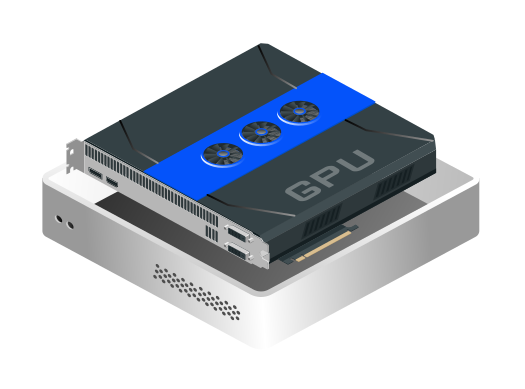
A GPU server is a high-performance server with a powerful graphics processor for parallel computing. It is used for AI/ML models, LLM inference, rendering, video transcoding, data analysis, and other heavy workloads.
Who Is This Service For?
For AI startups, developers, SaaS companies, design/architecture studios, video studios, and teams for whom a CPU-only server is no longer enough.
What Does the Customer Get?
Dedicated GPU resources, fast SSD storage, sufficient RAM, a secure network, and full Root/Admin access. Initial OS/driver/CUDA stack setup is available on request.
How to Choose?
The key factors are VRAM, GPU architecture, CPU/RAM balance, dataset size, latency, storage IOPS, and the software stack. We will help you choose the configuration based on your workload.
The GPU server package gives you dedicated GPU infrastructure with full Root/Admin access. The customer manages the server independently, while SERVER1.GE provides server delivery, network infrastructure, basic configuration assistance, and additional options on request.
Included in the Package
GPU server delivery with full Root/Admin access
OS installation and basic network configuration
Initial setup of NVIDIA Driver, CUDA Toolkit, and runtime environment on request
Docker / NVIDIA Container Toolkit installation if requested
Basic configuration of firewall rules and SSH access on request
Backup configuration on agreed storage - additional option
OS, kernel, application, and security updates are the customer's responsibility
Hardware/network incident diagnostics by SERVER1.GE
Ticket-based support for infrastructure, network, and availability issues
Important Terms
The GPU server is not a Managed service - the customer has full Root/Admin access
Daily management of the OS, applications, security updates, and configuration is the customer's responsibility
AI model tuning, code debugging, dataset processing, ML engineering, and research support are not included in the standard package
Commercial software licenses, rendering engine licenses, and paid AI tools are the customer's responsibility or are priced separately
Offsite backup, private network, HA architecture, and additional monitoring are priced individually
GPU availability and the specific model must be confirmed before ordering
High-load benchmarking, performance tuning, and DevOps services can be added as separate services
Root/Admin access is provided in full - responsibility for internal server management lies with the customer
GPU Server Advantages
A GPU server provides specialized computing power where CPU-only infrastructure is slow or expensive. SERVER1.GE helps you choose the right resources, launch the server, and ensure stable infrastructure delivery.
AI/ML Ready
The server is prepared for CUDA, Python, PyTorch, TensorFlow, JupyterLab, and containerized workflows.
Dedicated VRAM
GPU resources are dedicated for heavy inference, training, rendering, or data processing tasks.
NVMe Performance
Fast storage reduces delays in dataset loading, cache operations, and render output.
Predictable Cost
Renting a GPU server is often more predictable than usage-based cloud GPU costs.
24/7 Monitoring
Monitoring can be added as an additional option to track GPU utilization, VRAM, temperature, CPU/RAM, disk, and network.
Security Layers
Full Root access gives you complete control, while firewall, SSH hardening, and backup options reduce operational risks.
Flexible Stack
You can work with Docker, Python environments, a Kubernetes node, or a custom rendering pipeline.
DevOps Assistance
When needed, our team can help with initial configuration, adding monitoring, and performance tuning under a separate agreement.
Full Root Access, Security, and Support
The GPU server is delivered to the customer with full Root/Admin access, so OS, applications, security policy, and workload management are handled by the customer. SERVER1.GE provides hardware/network infrastructure, availability, and additional technical assistance by agreement.
GPU/VRAM/temperature/load monitoring
CPU, RAM, Disk, Network, and service checks
Firewall, SSH hardening, and brute-force protection
Backup frequency and retention - additional option
Maintenance window for updates and driver changes
SLA and response terms according to the agreed package
Operating Systems and GPU Stack with Full Root Access
The GPU server is delivered with full Root/Admin access and can be used for AI/ML, rendering, video processing, or a custom compute workflow.
Ubuntu Server
The most common choice for AI/ML and CUDA environments.
Debian / AlmaLinux
A stable environment for production workloads and enterprise policies.
NVIDIA Driver / CUDA
Initial setup of the appropriate driver, CUDA runtime, and GPU compatibility environment is available on request.
Docker GPU
NVIDIA Container Toolkit, Docker Compose, and reproducible deployment.
PyTorch / TensorFlow
AI/ML frameworks for a JupyterLab or API deployment environment.
Rendering / Video
Blender, FFmpeg, render pipeline, and GPU acceleration as needed.
What Is a GPU Server Used For?
A GPU server is especially effective for parallel computing where large volumes of data or visual workloads need to be processed quickly.
LLM Inference
Chatbot, RAG, embedding, private AI assistant, and API inference workloads.
Machine Learning
Model training, fine-tuning, data science notebooks, and experiment tracking.
3D Rendering
Blender/Cycles, architectural visualization, animation, and render queue.
Video Processing
FFmpeg acceleration, transcoding, upscaling, and media workflow.
Migration and Onboarding
Moving to a GPU environment starts with workload assessment: what software runs, how much VRAM is required, what the dataset size is, how many users or jobs run, and what uptime requirement exists.
Workload assessment - AI, rendering, video, or custom compute
Selection of GPU/CPU/RAM/NVMe configuration
Deployment of OS, driver, CUDA, and runtime environment
Secure access, firewall, and monitoring
Test launch and performance validation
Production cutover within an agreed window
Infrastructure Partners
Technology Partners
Customer reviews
SERVER1.GE customers especially value fast technical support, stable infrastructure and reliable service operation.
Fast responseCustomers value the responsiveness of our support team
Reliable infrastructureStable operation, reliable network and VPS infrastructure
Simple migrationOS choice, Dedicated IPv4 and root access
4.9/570+ Google Reviews
What do customers mention?
Customers frequently highlight fast support, service stability and human communication.
Who is this important for?
Businesses, online stores, agencies and projects that need dependable hosting infrastructure.
Dedicated servers offer isolation, control, predictable resources and greater flexibility for demanding workloads. Learn when dedicated infrastructure may be the right choice.
These server-management tools can improve security, administration and the efficiency of your daily workflow.
Frequently Asked Questions
Answers about choosing, managing, securing, and using a GPU server.
A GPU server is a server with a powerful graphics processor for parallel computing. It is used for AI/ML, rendering, video processing, and heavy computational workloads.
A regular Dedicated server is mainly CPU-oriented. A GPU server additionally gives you VRAM and thousands of parallel compute cores, which is much more effective for AI and rendering tasks.
The choice depends on model size, VRAM requirements, inference/training type, and the number of concurrent requests. T4/L4 may be enough for small inference, while a larger LLM or training workload requires an A100/L40S-type GPU.
Yes, initial preparation of NVIDIA Driver, CUDA Toolkit, runtime, and Docker GPU environment is available on request. After that, daily server management is handled by the customer through full Root/Admin access.
Yes, on a GPU server you can run PyTorch, TensorFlow, JupyterLab, a Python virtual environment, or a Docker container workflow. Initial stack setup is available by prior agreement.
Yes, a GPU server can be used for Blender, 3D rendering, architectural visualization, animation, and video processing tasks. When choosing a configuration, GPU model, VRAM, and storage speed are important.
Not necessarily. A GPU server can be Dedicated Bare Metal or a virtualized GPU resource. This page focuses on dedicated/high-performance GPU infrastructure.
VRAM is GPU memory where the model, batch data, or render workload is stored. If VRAM is insufficient, the job may fail to run or slow down significantly.
Yes. On a GPU server, the customer has full Root/Admin access. This means you can manage the OS, software stack, firewall, access policy, deployments, and configuration of all internal services yourself.
Yes, Docker, Docker Compose, NVIDIA Container Toolkit, and, if needed, a Kubernetes node can be prepared. The architecture must be agreed in advance based on the workload.
Monitoring is available as an additional option: GPU utilization, VRAM, temperature, CPU/RAM, disk, network, and core services. By default, the server is delivered with Root/Admin access for independent management.
Backup is configured according to agreed storage, frequency, and retention. For large datasets, a separate storage policy is often used because a full daily backup of all data is expensive and inefficient.
It depends on the workload. If you need GPU constantly, renting is often more predictable than usage-based cloud costs. For short experiments, cloud may be more flexible.
Yes, LLM inference, RAG, embedding, and private AI assistant workloads are possible. GPU choice depends on model size, quantization, concurrency, and latency requirements.
In the first stage, send us a description of the workload: what software/model you need, how much VRAM is required, how much storage you need, and what uptime requirement you have. After that, we will select the configuration and launch plan.
Need a GPU Server for AI, Rendering, or High-Performance Computing?
Send us your workload description and SERVER1.GE will help you choose the GPU configuration, location, storage, and necessary additional options. Get a GPU server with full Root/Admin access that truly matches your task.





 ️
️